
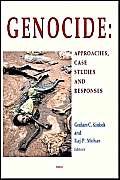
Genocide: Approaches, Case Studies, and Responses
Product details
| Management number | 231987663 | Release Date | 2026/06/18 | List Price | US$7.92 | Model Number | 231987663 | ||
|---|---|---|---|---|---|---|---|---|---|
| Category | |||||||||
In an era marked by significant political and social progress, genocide continues to devastate communities across Africa, Eastern Europe, the Middle East, and the Pacific. Genocide: Approaches, Case Studies, and Responses brings together fourteen leading scholars to examine one of humanity's most pressing challenges: understanding the causes of genocidal violence and developing practical strategies to prevent it.The book offers a comprehensive investigation into genocide from multiple angles. It begins with theoretical frameworks that identify the roots of genocidal behavior, tracing how ethnocentrism and intergroup competition create conditions for mass violence. The authors examine the sociological context of genocide, exploring how modern societies—despite their technological advancement—remain vulnerable to organizing systematic destruction against targeted populations.The collection moves beyond abstract theory to analyze specific historical and contemporary cases. A detailed study of the Herero genocide in German colonial Africa reveals how colonial discourse constructed racial hierarchies that justified annihilation. An ecological analysis of the Rwandan genocide examines how resource scarcity and environmental stress intersected with ethnic tensions to produce catastrophic violence. These case studies illuminate patterns that help explain why genocide recurs despite international awareness and humanitarian progress.Importantly, the book addresses often-overlooked dimensions of genocide. Chapters on survivors and victims provide biographical insights into how trauma reshapes lives across generations and how survivors construct meaning from catastrophe. The authors grapple with difficult questions: How do we document experiences that defy language? What responsibilities do survivors carry? How do traumatic memories shape identity and community?The volume also tackles conceptual challenges. What exactly constitutes genocide? How has the term's definition shaped international response—or lack thereof? Contributors examine how political reluctance to use the word "genocide" enables inaction, and how the framing of mass violence affects our moral and legal obligations.Finally, the book addresses policy implications. Rather than offering naive optimism, the authors argue that preventing genocide requires confronting uncomfortable truths about human nature, institutional failure, and the persistence of discrimination against minorities. They consider what practical steps nations and international bodies might take to interrupt cycles of violence.This is essential reading for students of history, political science, sociology, and international relations, as well as for anyone seeking to understand how humanity can prevent future atrocities. The book combines rigorous scholarship with urgent moral questions, offering both intellectual substance and practical insight into one of the defining moral challenges of our time. Read more
| ISBN10 | 0875863795 |
|---|---|
| ISBN13 | 978-0875863795 |
| Language | English |
| Publisher | Algora Publishing |
| Dimensions | 6 x 0.76 x 9 inches |
| Item Weight | 1.1 pounds |
| Print length | 336 pages |
| Publication date | December 1, 2005 |
Bestseller ranking
Under Cabinet Range Hoods






Customers who viewed this product also viewed
Biological & Chemical




Correction of product information
If you notice any omissions or errors in the product information on this page, please use the correction request form below.
Correction Request Form